Sunday, September 27, 2020

What is Blog?

A blog (a shortened version of “weblog”) is an online journal or informational website displaying information in the reverse chronological order, with the latest posts appearing first, at the top. It is a platform where a writer or a group of writers share their views on an individual subject.


What is the purpose of a blog?

There are many reasons to start a blog for personal use and only a handful of strong ones for business blogging. Blogging for business, projects, or anything else that might bring you money has a very straightforward purpose – to rank your website higher in Google SERPs, a.k.a. increase your visibility.

As a business, you rely on consumers to keep buying your products and services. As a new business, you rely on blogging to help you get to potential consumers and grab their attention. Without blogging, your website would remain invisible, whereas running a blog makes you searchable and competitive.

So, the main purpose of a blog is to connect you to the relevant audience. Another one is to boost your traffic and send quality leads to your website.

The more frequent and better your blog posts are, the higher the chances for your website to get discovered and visited by your target audience. This means that a blog is an effective lead generation tool. Add a great call to action (CTA) to your content, and it will convert your website traffic into high-quality leads. A blog also allows you to showcase your niche authority and build a brand.

When you use your niche knowledge for creating informative and engaging posts, it builds trust with your audience. Great blogging makes your business look more credible, which is especially important if your brand is still young and fairly unknown. It ensures presence online and niche authority at the same time.

Blog structure

The appearance of blogs has changed over time, and these days blogs include a wide variety of items and widgets. However, most blogs still include some standard features and structure.

Here are common features that a typical blog will include:

  • Header with the menu or navigation bar.
  • Main content area with highlighted or latest blog posts.
  • Sidebar with social profiles, favorite content, or call-to-action.
  • Footer with relevant links like a disclaimer, privacy policy, contact page, etc


Sales Objection

A sales objection is a rebuttal from your current lead during the sales process that explicitly states a reason why they will not be buying from you at the moment. These can include problems with price, usefulness of the product, or a lack of time to engage with you currently, among other things.

Here’s one important thing every seasoned salesperson understands:

Getting an objection from a client is a good thing! It means the prospect has enough interest to at least engage with you, rather than flat out dismissing you. For you, the salesperson, a sales objection is an opportunity to learn more about your prospect’s needs, and find better ways to communicate the value your solution has to offer to them.


10 proven strategies for overcoming objections in sales

  1. Really listen to the objection - You might think jumping in with a quick response is the best tactic, but it’s much better to listen carefully to what they are saying so you don’t make assumptions about what they want/what they mean.
  2. Take the time to understand the objection - Ask further questions about what they mean, as it’s common that your potential buyer isn’t revealing their real objections. Explore with them to get to the real root of the issue that’s holding them back.
  3. Craft a response addressing their biggest objection - Once you understand it, provide a rebuttal to their concerns. If you can overcome this barrier, the call can likely continue with less resistance.
  4. Try to resolve their objection in real time - The better you can satisfy their concerns right away, the more likely they are to proceed further in the sales process.
  5. Keep responses clear and to the point - A long response where you go on and on isn’t likely to be well-received, but instead, seen as more ‘selling’ and less like addressing their concerns.
  6. Don’t wing it - Making up things on the spot is likely to get you in trouble; buyers can sense this and it will create a level of distrust that - in all likelihood - will end the sales call. If you need more information, ask for it, or look it up.
  7. Confirm you’ve satisfied the objection - Don’t assume you have just because they accept what you say. Ask your potential buyer how they feel about what you’ve said, or if you’ve alleviated their concerns. This can help you move in for the close, or if necessary, move on to addressing further concerns they have.
  8. Create an objection management document- This document should list the top 25 objections you face, along with a 1-3 sentence response for each. If you work with a team, collaborate on this project together.
  9. Practice the objection responses and commit them to memory - You don’t have to recite them word-for-word, but you should at least have them in the back of your mind so you have a strong foundation and can deliver confident, compelling responses every time.
  10. PRO TIP: Customize your objection list to market - Each market has its own objections, and if you aren’t prepared for those, you’re going to lose deals to someone that is. Sort your objections into groups by market, and add objections you get from only certain areas.

Monday, September 7, 2020

Artificial Intelligence

 AI is intelligence exhibited by machines, or when machines mimic or can replace intelligent human behavior, such as problem-solving or learning.

It can be applied in two ways:

  1. Automating processes and actions so they can operate without the need for human intervention
  2. Assisting the human decision-making process in day-to-day operations by reducing errors and identifying bias, especially in data analysis
How Smart is Artificial Intelligence? | by MIT IDE | MIT Initiative on the  Digital Economy | Medium

AI applications in logistics:-
Warehouse logistics and transport operations generate huge volumes of data. To gain full benefit from this data we need to apply analytic tools to gain better insights.   Machine learning techniques can be used to streamline and automate processes such as load forecasting and vehicle scheduling. New AI software includes functionality that teaches computers how to provide real-time information from the raw data, on which key decisions then are based.
Supply chain planning

ML can provide the best possible demand scenarios based on intelligent algorithms and machine-to-machine analysis of big data sets, using work tools that run in a continuous loop. This kind of capability could optimize the delivery of goods while balancing supply and demand, and wouldn’t require human analysis except for the setting of parameters.

Supplier management
Supplier risk is a huge concern for global organizations that have decentralised operations and AI can help. Data that is generated from supplier activity such as physical audits, supplier performance assessments and product failures provides an important basis for sourcing decisions. Supplier relationship management (SRM) is still mainly a human activity based on the use of available data, however stale or incomplete. Machine-to-machine automation can provide multiple ‘best supplier scenarios’ based on whatever parameters the user chooses.

How to write an effective blog?

 This is the era of blogs and with the competition increasing creating a blog post is harder than before. Below are 5 tips that should be focused while writing a blog.

4 Tips To Create Amazing Blog Content - Gareth O'Sullivan

1. Listen to Your Customers

A sure way to come up with great ideas for your content is by listening to your customers. Your customers are asking questions and by developing content that answers these specific questions, you are essentially answering your customers directly. Pay attention to what your customers want to know and focus on addressing this subject matter. Customer-centric content will help attract new customers and delight existing ones.

2. Do Your Homework

The best blog content is always preceded by research. You should closely examine what others have written before embarking on your own content. Thorough research provides you with new ideas and gives you the opportunity to include subject matter you would have otherwise missed. A proven course of action is to read others' content and improve on it in your content. It is commonly referred to do as content curation.

3. Make it Easy to Read

One of the key characteristics of effective blog posts is that they are easy to read and digest. Ensure that your content flows nicely, and interject descriptive subtitles, insert quotes and use bullet points or numbered lists. Subheadings and lists can help the reader quickly navigate to the desired information. Finally, keep your posts short. If a post runs too long, break it up into two separate articles or parts. Limit the length of your posts to 1,000 words.

4. Use Visuals

Renowned psychologist Albert Mehrabian demonstrated that a whopping 93%  of communications are non-verbal. It is important to use visuals like diagrams, schematics, infographics, and screenshots throughout your posts to support and expand on your information. According to Moz, videos may also be embedded into posts. Posts with videos get 267% more links than those without videos. Visuals are important because they help break up and support the information, and they provide "resting points" for eyes when reading and absorbing an article.

5. Maintain an Idea List

You may not have the resources and bandwidth to generate a lot of blog content in one writing session. You will get new ideas and suggestions along the way. You may see an article you enjoyed, or a conversation with a client or a colleague may give you an idea for the next post. Write all of them down. A continuously updated list of potential topics will ensure that you don't run out of ideas for your blog.


Sunday, September 6, 2020

Shanti Mantra

 In our Business Communication Class , our Prof. T Prasad taught us Shanti Mantra and the power of Shanti Mantra and how it helps in our life in achieving our goals.

He also made us chant and explained how it is important to take correct pauses while reciting the mantra.

    ॐ सह नाववतु ।
    सह नौ भुनक्तु ।
    सह वीर्यं करवावहै ।
    तेजस्वि नावधीतमस्तु मा विद्विषावहै ।
    ॐ शान्तिः शान्तिः शान्तिः ॥

    Om Saha Naav[au]-Avatu |
    Saha Nau Bhunaktu |
    Saha Viiryam Karavaavahai |
    Tejasvi Naav[au]-Adhiitam-Astu Maa Vidvissaavahai |
    Om Shaantih Shaantih Shaantih ||

Shanti Mantra With Lyrics | Om Saha Navavatu 11 Times - video dailymotion

The meaning of Shanti Mantra is :-

1)OM, may we all be protected(in our Studies, the Teacher and the Student),
2)May we all be nourished (our Studies, the Teacher and the Student),
3)May we work together with great energy.
4)May our studies be enlightening.
5)Let us not give rise to enmity.
OM, peace (within), peace (with each other), peace (universal).

#MandiSir #NITIE #BusinessCommunication

Smart Goals!!


Goal setting is a helpful way to build the career you want. By setting objectives and creating a clear roadmap for how you’ll reach your intended target, you can decide how to apply your time and resources to make progress. Without goals, it can be difficult to determine how to get a certain job, promotion, or other milestones you want to achieve.

When you set an objective for yourself, you should include each step necessary for success. To help, you can use a framework called SMART goals. Here’s how SMART goals work and a few tips and examples to assist you in your goal-setting efforts.

The Importance of Setting SMART Goals

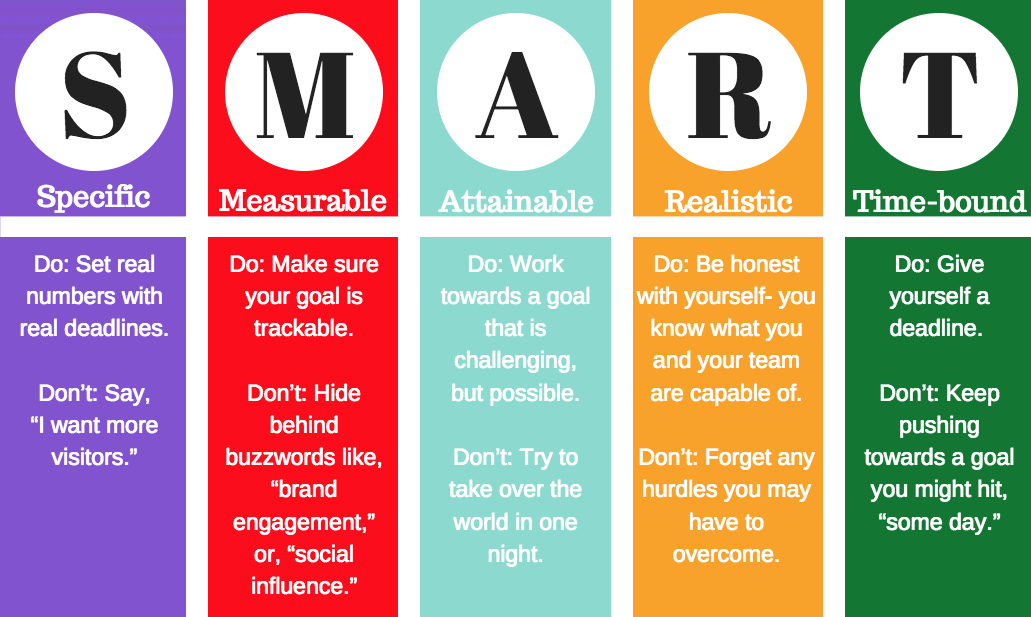
What are SMART goals?


S = Specific

Be as clear and specific as possible with what you want to achieve. The more narrow your goal, the more you’ll understand the steps necessary to achieve it.

M = Measurable

You need to be able to measure these goals.
Examining a key metric and quantifying your goals will help track your progress. It will also identify the mark at which you’ve completed your task.

A = Achievable

Why do you want to reach this goal? Is it important for you or your organization?

R = Relevant

Why do you want to reach this goal? Is it important for you or your organization?

Once you identify the key benefit, add that into your goal so it helps your team members understand the importance of the goal and how it contributes to the bigger picture.

T = Time-based

This is one of my favorite parts of SMART goals….setting the deadline.

The timeframe will create a sense of urgency. It functions as a healthy tension that will springboard you to action.

5 Elements of a SMART Business Goal

Hyperloop

  With the emergence of the technology from the times, Humans have covered a long journey of crawling on the earth to flying in the space. F...